Art Is Impossible Without National Socialism
Disgustingly Anti-Cultural Film Northface Proves the Creative Barrenness of Liberalism

Liberals overvalue originality. To them, the main virtue of any work of art is that it goes against what is expected.
Because of this attitude, liberal “intellectuals” are quick to praise a work even if—by all objective measures—it is a disgusting parody of taste.
A perfect example of this is the 2008 German movie Northface, about four mountaineers who try to climb the impossibly steep, over-a-mile-high, north face of the Eiger mountain in the Alps.
Northface is an eye-rollingly artless allegory of bourgeois liberalism against real White-people values… against National Socialism. Despite what liberal and Jewish reviewers said, it is not at all subtle.
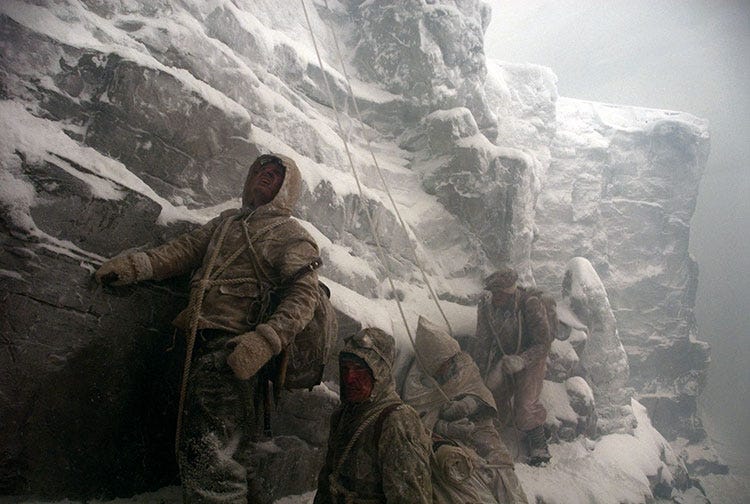
It’s funny how something can affect you at different times in your life, especially when you undergo a major shift in your political understanding. I had seen Northface for the first time sixteen years ago as a relatively normal liberal college student—albeit with certain irrepressible Nazi tendencies. I decided to rewatch it the other day, having forgotten the plot. I remembered only that two Wehrmacht guys love climbing mountains and get into a competition to conquer the last, most difficult summit in Europe.
Rewatching it, I was appalled its emphasis on awful death and suffering… its tastelessness, vulgarity and overwhelming nihilism.
Oh sure, the nature-views were still beautiful, the early climbing scenes were exhilarating, the chalets and alpine trains stirred up fantasies of quaint travel and relaxation. But this movie was no mere historical tragedy like Titanic or Gladiator. Instead it is a vicious attack on European culture.
The movie gives us two pairs of climbers: the first pair are Germans who are depicted as experts at their craft and well attuned to nature. They are also disdainful of National Socialism. The second pair are Austrian National Socialists who try to make up for their deficiencies in mountaineering-skill and nature-knowledge through cheating and an overreliance on willpower. Early on in the climb, as the Austrian Nazis are following in the path of the apolitical Germans, some rocks fall on the head of one of the Austrians. It turns out, he has a horrible, life-threatening gash in his skull. He stubbornly pushes on. Eventually, when the climber—not so subtly named Willy—cannot go any farther, the other Austrian and the two Germans are forced to turn back in order to save him. The weather gets worse, everyone gets more and more injured and the movie ends with them all dying hopeless deaths.
A bad medieval theologian could hardly have written a more blatant allegory. As the movie shows it, National Socialism is pig-ignorant willfullness with no regard whatsoever for skill or an appreciation of facts as they are. Apolitical liberalism, on the other hand, is both more skilled and more in tune with the essence of man and of nature. The German liberals get killed because of the Austrian Nazis’ hubris. We are supposed to see here a direct foreshadowing of World War II.
The thing is, it isn’t the Nazi climbers who are at odds with reality, but the movie itself. Actual Nazi heroes—as shown in lots of Nazi movies—combine all three virtues: nature-alertness, highly developed expertise, and well-honed but judiciously applied willpower. To give but one example: in Karl Ritter’s brilliant and tragic 1937 movie Unternehmen Michael, the main character is a WWI staff-officer who is a past-master of his craft: operational planning. The plan is to seize a village, but the captain slotted to lead the attack is injured the night before the attack can begin. So the staff-officer, Major zur Linden, volunteers to lead the attack himself. He has to take the lead because he has the best knowledge of the plan itself and of the local conditions. He has the maps and troop-dispositions memorized.
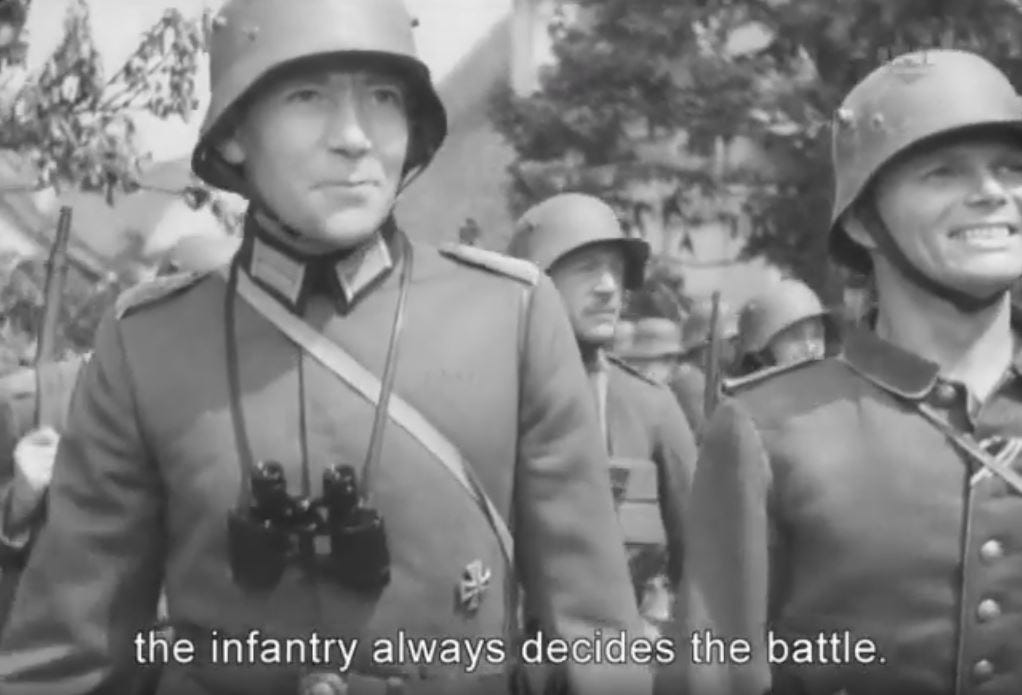
After taking the village, the major finds himself and his men surrounded by the British. The other German regiments cannot pass the village without being mowed down by British machine guns, and zur Linden’s force is too small and weak to break out. So—here is the judiciously applied willpower—he calls in an artillery-strike on his own position to annihilate the surrounding British and open the way for the rest of the offensive. It is important to note here that he isn’t some glory-thirsty idiot who rushes into a hopeless situation and gets his men killed. He is a detail-oriented genius of a practitioner who also leads from the front, sacrificing himself and his men, because there is no other way.
Northface, by contrast, gives the viewer not a tragic end but a soul-sapping and nihilistic one. Instead of an obligation to die for something good, it gives us a moral obligation to die for nothing. The two Austrians die by the elements. The first dies from his head-wound, the second by strangulation. One German finds himself stranded on a ledge, the second dangling by a rope, unable to climb fast enough before the carabiner is ripped out of the rock. To save his buddy, he cuts the rope and falls to his death. The sacrifice is in vain, because it only condemns the other man to a long, agonizing death by freezing.
This is not artistic. Actual tragedy demands that some justification be given for suffering—that either through some immoral action or through a character flaw. The only possible flaw of the German characters is that they tried to help the Austrians by agreeing to come down the mountain with them. What was the other option? To strike out for the summit themselves, leaving the head-wounded Austrian and his buddy to die? That would be a literary impossibility, because it would mean that the Germans characters are not good, helpful liberals. Perhaps if the liberals were wounded, the heartless Nazis could have left them behind to die cold and alone. That would have met the standard of tragedy. But that’s not how the plot runs.
So the only conclusion one can draw is that the liberal Germans died because of their liberalism. They were too tolerant to the Nazis and therefore died because of it. Of course, this contradicts the very point of the liberal belief-system. There is thus no possible action that they could have taken to be good. In the moral world of Northface, there is both nothing they could have done and they deserve to die because of it. Contrast this with actual art like Shakespeare’s Macbeth. Macbeth could have overcome his ambition and not listened to his psycho-bitch wife. He could have not killed King Duncan, and kept his place as the hero of the realm. He dies because he is imperfect, NOT because it is metaphysically impossible to be good.
Given that Northface cannot be regarded as a tragedy, I suppose you could argue that it’s a dark comedy… dark comedy being marked by the characters suffering more than they deserve to. Aristophanes’ The Clouds is a dark comedy because Strepsiades is a greedy idiot and Socrates is a bloviating fraud. It ends with Strepsiades getting beaten by his own son and Socrates’ school getting burned down by an angry mob. That is what literary theorists and men of taste call “funny”—that is, a technical term describing a story wherein a character of low moral value suffers worse than he deserves to. In The Clouds, both characters suck and fate punishes them for it. The problem with Northface is that the German liberals are given way too many admirable traits for their abjectly miserable deaths to make any sense.
The subversion runs even deeper. Like all German stories of the last two centuries, Northface has strong Goethean undertones. Of course, these are subverted. The final words of the last dying mountaineer are “ich kann nicht mehr” (I can no more), which clearly reflects the words that Faust must say to signal his satisfaction with life and readiness for death “Were I to say to a moment / tarry now, you are so pretty” (Werd’ ich zum Augenblicke sagen / Verweile doch, du bist so schön). The difference is, Faust can only die if he strives for nothing more, that is, if he is satisfied with his accomplishments. “Ich kann nicht mehr” on the other hand means that the mountaineer accepts that death and his life have been meaningless.
Again, this is nihilism, not art. Nihilism is the very definition of the devil in Goethe’s Faust “ich bin der Geist der stets verneint” (I am the spirit that ever negates). We can be sure that these Goethe parallels are intentional, for one thing, because the director, Philipp Stölzl, is a German, and for another, because he was working on a production of Charles Gounod’s opera Faust at the same time as Northface and further, because his next project was a movie about Goethe.
Maybe Herr Stölzl might perhaps defend himself on a Faustian basis. “Look, all the other art has been tried, ja, I’m trying to create something new. Ze characters cannot reach the summit, or survive, or even die with some shred of purpose or justification. Any attempt to do otherwise would be trite and boring. One might even accuse me of stooping to sentimentality of ze American type.”
This would be retarded. First of all, we already have a nihilistic do-over of Goethe’s Faust in the mentally diseased novel Doktor Faustus by literal homosexual-incestuous-pedophile Thomas Mann. Second, the answer to the exhaustion of European artistic possibilities is not to write nihilist smut but—as Oswald Spengler pointed out in 1918—to shift from Art to applied fields like politics, law or engineering. “Art for the sake of art” might be dead, but art for the sake of politics certainly isn’t. Art has two political uses: helping Western man to understand the world as it is and refining in him the desire to improve it. As a political matter, that can only mean fighting the Jews. “Art” thus should be aimed at two things: spreading the truth (propaganda) and developing a more subtle understanding of it—“raising the cultural level”, as Hitler put it.
Herr Stölzl should be embarrassed. Despite being educated in Europe, despite having direct access to Goethe through his native tongue, his movie is so tasteless and cultureless that I—an American—am sensitive enough to call him out.
The bigger conclusion to draw from Northface is that liberalism cannot produce real art. In fact, ironically, the movie proves the opposite of what it intended to. In attempting to slander National Socialism as morally bankrupt, it accidentally proves the artistic barrenness of liberalism.
Tragedy requires an internally consistent morality, and Northface hasn’t got it. Its characters don’t suffer because they deserve it, they don’t suffer despite being good (like Job), they don’t suffer because they have to for some greater purpose. They must suffer because they are good. This is a perversion of every outlook on ethics—Aristotle, normal Christianity, Kant. The only “moral” system under which this makes sense is judaism, where men deserve to die agonizing deaths for the sin of not being Jewish.
So, I recommend that you DO NOT EVER watch this movie. It will poison your soul and demoralize you, as if any of us needed more of that. It might be necessary to grapple with darkness and horror, but one should not wallow in it.
Instead, you should watch movies made by artists who are Aryan in blood and in spirit. I recommend Karl Ritter (you can find a lot of his movies on Odysee). If you want a movie about mountain-climbing that isn’t a grotesque assault on taste, I suggest Leni Riefenstahl’s Bergfilme (mountain-movies).
Art might need novelty, but it also needs moral consistency. Art’s potential is therefore limited by the moral power of the people trying to create it. And if you want more people to have that potential, you need a society organized to foster it. Our present system—based on Jewish anti-ethics and liberalism’s unwillingness to confront that—cannot produce artists, only muddlers and nihilists.
The creative impulse is predicated upon the willingness to sacrifice for something greater than yourself… as Hitler points out again and again. This is the only way to produce art in the highest sense—not art for propaganda or art for education but pure art, “ars gratia artis”. You need a whole society organized according to a sensible, Aryan moral system.
If we ever want to get back to creating high art, we’re going to need a total National Socialist revolution.
If you see nazi characters in a movie made by a libtard you know its excuse for the writer to be needlessly sadistic. The libtard/leftoid wants to remove your fingernails and genitals with 0 internal conflict about their belief that they embody fully ascended moral purity.
The point is solid and I can appreciate it. I just cringe at having to align myself with any past regime or seeing it as a kind of implicit prerequisite. I would rather draw from multiple historical sources to develop a "social-national" philosophy for a particular people in a particular place; in your case, "White Americans" without having to say, "we endorse the full 12 years of the NSDAP" or alternatives for the far-left "we endorse everything after 1953, but not the stuff after 1937." I just feel there is something limiting about it. For example, I find that Jack London's work "White Fang" or the "Sea Horse" captures more of what you would find acceptable. But I also like some of his "liberal bourgeois" works as well, such as his "Martin Eden" ( which the far-left would hate ) but the far-right might just barely tolerate. I might draw from pre-20th century authors to make the same social-nationalist points and conditioning.